Before class on Monday, Oct. 24,
- Please watch the three videos below (12 min, 16 min, 14 min)
- Complete the note packet labelled Lessons 3.3-3.4
- Make a comment
Before class on Monday, Oct. 24,
Before class of Oct. 20:
sd
Sorry class, the test is tomorrow. You are more prepared than you think. Titration will not be on the test. From unit 1, focus on empirical formula, % composition limiting reactants, and % yield. From Unit 2, focus on how electrolytes dissociate in water, identifying if a substance is soluble or insoluble from solubility tables, neutralization reactions, precipitate reactions, redox reactions (and for all three types writing the molecular reaction and the net ionic reaction.) and molarity. ON the test you will have a question similar to your lab report calculations, a question like #28 on the homework packet, and you will have to explain how to create a solution of certain molarity from mass and dilution, just like we did in class the other day. When reviewing HW packet #1, focus on ?s # 3,5,9,10,11,12,14,16 and 17. From packet #2, focus on ?s #1,2,5,7-11, 14-16,19 and 28.
Before class on Oct. 12,
Think: List one current event topics that you might understand better if you had a better understanding of energy.
With the exception of energy from the Sun, most of the energy used in our daily lives comes from chemical reactions. The combustion of gasoline, the production of electricity from coal, the heating of homes by natural gas, and the use of batteries to power electronic devices are all examples of how chemistry is used to produce energy. Even solar cells rely on chemistry to produce the silicon and other materials that convert solar energy directly to electricity. In addition, chemical reactions provide the energy that sustains living systems. Plants use solar energy to carry out photosynthesis, allowing them to grow. The plants in turn provide food from which we humans derive the energy needed to move, maintain body temperature, and carry out all other bodily functions.
List three ways we use energy in our daily lives:
Think: It is evident that the topic of energy is intimately related to chemistry. What exactly is energy, though, and what principles are involved in its production, consumption, and transformation from one form to another? Write down your thoughts about this question now.
If you were absent from class today, or just need a review, today our guiding question was:
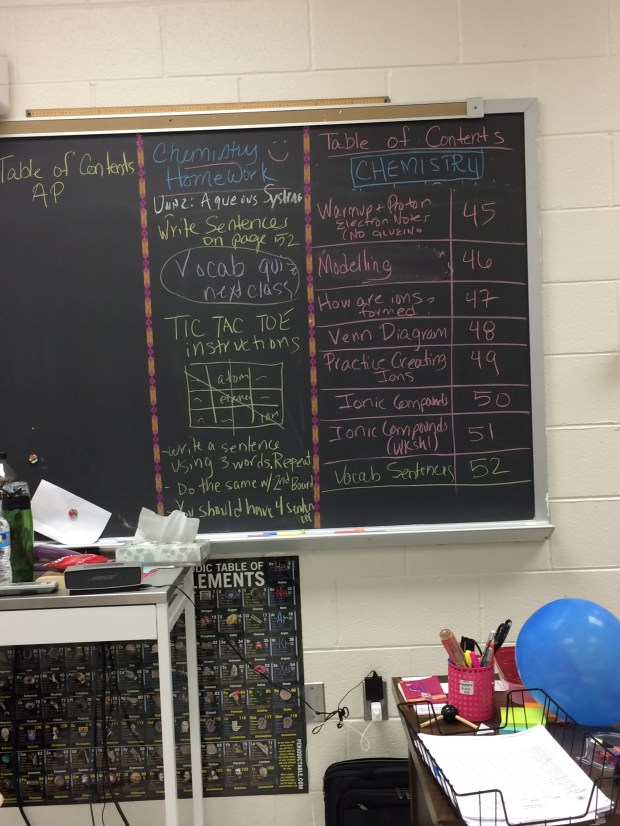
Here is a picture of the Table of Contents from today:
By the end of the lesson today, you will have learned how to:
 chemistry matters